
One Platform.
Every Conversation.
Designed a unified enterprise communication platform that brings Voice, SMS, WhatsApp, Email and RCS into one scalable ecosystem for enterprise businesses.
- Role
- Lead Product Designer
- Timeline
- 2024 – Present
- Platform
- Enterprise SaaS
- Channels
- Voice·SMS·WhatsApp·Email·RCS
- Users
- Business·Marketing·Operations·Support
The Vision
Enterprise communication was becoming increasingly fragmented. Businesses relied on separate platforms for SMS, WhatsApp, Voice, Email, and RCS—each with its own workflows, permissions, templates, reporting, and operational overhead.
Our vision was to bring every communication channel together into a single enterprise platform that provides a consistent experience, centralized governance, and the flexibility to scale as businesses grow.
Rather than designing another messaging product, we set out to create a communication operating system that unifies channels, simplifies complexity, and lays the foundation for AI-driven customer engagement.
The Problem
Enterprise communication had evolved channel by channel over many years. As organizations adopted new messaging technologies, each channel introduced its own tools, workflows, permissions, reporting models, and user experiences. Instead of a connected ecosystem, teams were managing multiple disconnected products that increased operational complexity and reduced efficiency.
Fragmented Platforms
Every communication channel required its own product and management experience.
Inconsistent Experience
Navigation, terminology, permissions, and workflows varied across channels.
Operational Complexity
Teams constantly switched between multiple interfaces to manage customer communication.
Limited Scalability
Introducing new channels or enterprise capabilities became increasingly difficult.
Fragmentation → Friction → Unification
The Opportunity
Enterprise communication was rapidly evolving, but organizations were forced to manage disconnected products for every channel. Instead of adding another communication tool, the opportunity was to rethink how enterprise messaging should work as a unified platform.
By bringing Voice, SMS, WhatsApp, Email, and RCS together under one product, we could establish a single design language, centralized governance, reusable workflows, and a scalable architecture capable of supporting future AI-powered experiences.
The goal wasn't simply channel consolidation—it was to create a platform that reduces operational complexity, improves consistency, and enables enterprises to communicate intelligently at scale.
Unified Platform
One ecosystem replacing multiple disconnected communication products.
Scalable Foundation
A modular architecture designed to support future channels, AI capabilities, and enterprise growth.
Consistent Experience
Shared workflows, reusable components, and centralized governance across every communication channel.
One Platform.
Multiple Communication Experiences.
1SPOC was designed as a unified enterprise communication platform where every channel shares the same foundation instead of operating as independent products. Common services like templates, journeys, analytics, governance, and AI create a consistent experience across the entire ecosystem while allowing each communication channel to retain its unique capabilities.
Unified Channels
Every communication channel operates through one shared platform instead of independent products.
Shared Services
Templates, automation, analytics, and governance are reusable across every communication experience.
Modular Architecture
The platform is designed to scale with new communication channels and enterprise capabilities.
AI-Ready Foundation
The ecosystem provides the foundation for conversational AI, intelligent automation, and enterprise insights.
Business Challenges
Designing 1SPOC wasn't simply about creating better interfaces. It meant balancing business goals, operational workflows, technical constraints, regulatory requirements, and the needs of multiple enterprise teams. Every design decision needed to support long-term scalability while maintaining a consistent and intuitive user experience across the platform.
Fragmented Product Ecosystem
Multiple communication products had evolved independently, resulting in inconsistent experiences, duplicated functionality, and disconnected workflows.
Diverse Enterprise Personas
The platform needed to serve Product Managers, Marketing Teams, Operations, Administrators, Customer Support, and Business Users with different goals and responsibilities.
Complex Permissions & Governance
Support enterprise-grade role-based access, approval workflows, audit logs, and centralized governance across every communication channel.
Cross-Channel Consistency
Deliver a unified experience while respecting the unique capabilities of SMS, Voice, Email, WhatsApp, and RCS.
Scalability & Future Expansion
Design an architecture capable of supporting future communication channels, AI capabilities, automation, and enterprise integrations.
Engineering Constraints
Balance technical feasibility, reusable components, backend architecture, and implementation efficiency throughout the platform.
“Enterprise design isn't about simplifying complexity. It's about organizing complexity into experiences people can confidently use.”
Research & Discovery
Before exploring solutions, I collaborated with product managers, engineering teams, business stakeholders, and existing platform workflows to understand how enterprise communication operated across multiple channels. This discovery phase helped identify operational friction, validate business priorities, and establish a clear direction for a scalable platform.
Stakeholder Workshops
Align business goals and product vision.
Platform Audit
Identify inconsistencies across existing products.
Workflow Analysis
Understand enterprise communication processes.
Engineering Collaboration
Validate technical feasibility and scalability.
Competitive Benchmarking
Study enterprise communication platforms.
Customer & Support Insights
Understand recurring operational pain points and feature requests.
Key Outcomes
Principles That Guided Every Decision
Enterprise platforms are rarely constrained by interface design alone. Every decision in 1SPOC was guided by a set of product principles that balanced usability, scalability, business goals, and technical feasibility. These principles became the foundation for creating a consistent experience across every communication channel.
Enterprise First
Design for enterprise workflows, governance, permissions, and operational scale—not individual screens.
Consistency Over Customization
Every communication channel should feel like part of one product while preserving channel-specific capabilities.
Modular by Design
Build reusable patterns, shared components, and scalable architecture instead of isolated solutions.
Reduce Cognitive Load
Simplify complex workflows through progressive disclosure, clear hierarchy, and predictable interactions.
Collaboration by Default
Support seamless collaboration between Product, Business, Operations, and Engineering through shared workflows and governance.
AI-Ready Foundation
Design flexible systems capable of supporting intelligent automation and future AI-driven experiences.
“Good interfaces solve tasks. Great platforms establish principles that scale across products, teams, and future capabilities.”
Designing a Platform, Not Just Features
Rather than designing independent channel experiences, the strategy behind 1SPOC was to establish a modular product architecture. Shared capabilities such as templates, journeys, analytics, permissions, and AI were designed once and reused across every communication channel. This reduced operational complexity, accelerated product development, and ensured a consistent enterprise experience.
PlatformUnified Product Architecture
One platform replacing multiple disconnected communication products.
Modular Product Design
Reusable modules support rapid expansion without redesigning the platform.
Shared Design Language
Common navigation, interaction patterns, and components across every channel.
Future-Ready Platform
Designed to support AI, automation, integrations, and enterprise growth.
“The biggest design decision wasn't creating better screens. It was defining a product architecture that could evolve without becoming more complex.”
Platform Architecture
A unified architecture that brings every communication channel, intelligence layer and enterprise capability into one scalable platform.
Enterprise Omnichannel Communication PlatformDashboard
Overview & Insights
Campaigns
Create, Manage & Track
Channels
All Communication Channels
Templates
Create & Manage Content
Analytics
Measure & Optimize
AI Assistant (CoCo)
Ask, Generate & Automate
SMS
Bulk, Transactional, Promotional
Business Messaging, Flows, Templates
Transactional & Promotional
Voice
Voice Calls, IVR, Voice Bots
RCS
Rich Communication Services
Journey Builder
Visual Workflows & Automation
Automation
Triggers, Schedules, Workflows
Content Management
Templates, Media, Variables, Assets
Integrations
API, Webhooks, Third-party Apps
Approval Workflows
Review, Approve, Publish
AI Campaign Generator
Create campaigns using natural language
AI Content Generator
Generate templates, messages, and variants
AI Insights
Smart analytics & actionable insights
Conversation Intelligence
Understand interactions and sentiments
AI Recommendations
Channel, content and audience recommendations
Users & Roles
Permissions & Access Control
Organization
Business Units, Brands, Hierarchy
Security
Authentication, SSO, Policies
Billing & Wallet
Plans, Usage, Invoices, Payments
Audit & Logs
Activity Logs, Audit Trails, Compliance
System Settings
Configuration, Preferences, Controls
Developer & API
API Keys, Docs, Rate Limits
Unified Experience
One platform. Consistent experience across every channel and workflow.
Modular & Scalable
Build, extend and scale with independent yet connected capabilities.
Intelligent by Design
AI embedded across the platform to automate, predict and optimize.
Secure & Governed
Enterprise-grade security, role-based access, governance and compliance.
Want to explore the complete platform architecture?
The full Information Architecture shows how 1SPOC is structured across communication channels, shared platform services, AI capabilities, analytics, and enterprise administration.
From Complexity to Clarity
Designing an enterprise platform is an iterative process. As product requirements evolved and stakeholder feedback surfaced, the experience continuously matured through simplification, standardization, and reusable design patterns. Every iteration brought the platform closer to a scalable and cohesive ecosystem.
Exploration
Early concepts focused on individual communication channels with inconsistent workflows.
Alignment
Shared layouts and navigation patterns emerged across products.
Standardization
Reusable components, templates, and interaction patterns established consistency.
Unified Platform
A scalable enterprise design system supporting multiple channels through one cohesive experience.
Simplification
Removed duplicated workflows and reduced unnecessary complexity.
Standardization
Unified navigation, terminology, and interaction patterns across the platform.
Reusability
Introduced shared components and scalable design patterns.
Scalability
Prepared the platform for future channels, automation, and AI capabilities.
Campaign Builder
Drag to compare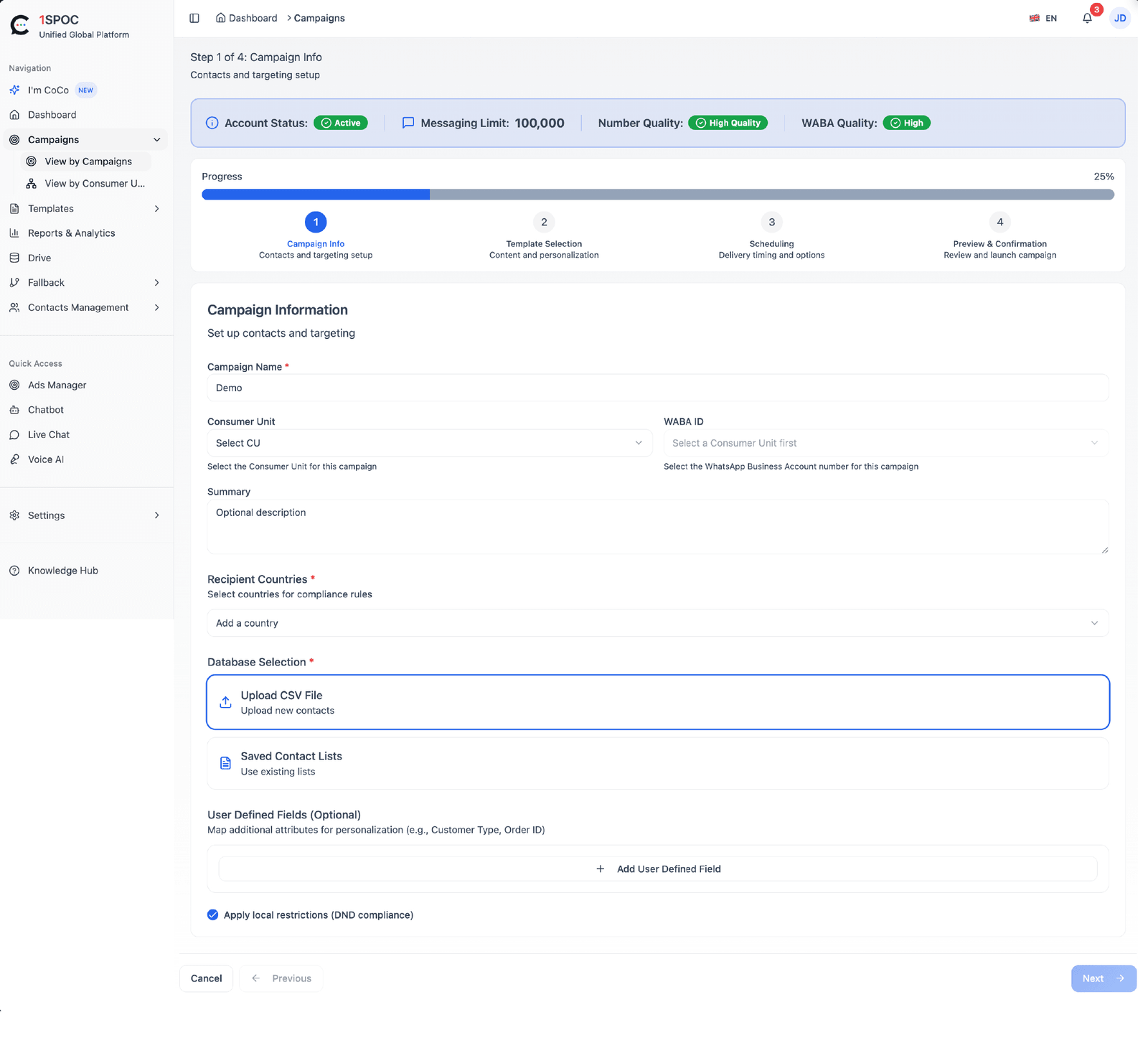 After
After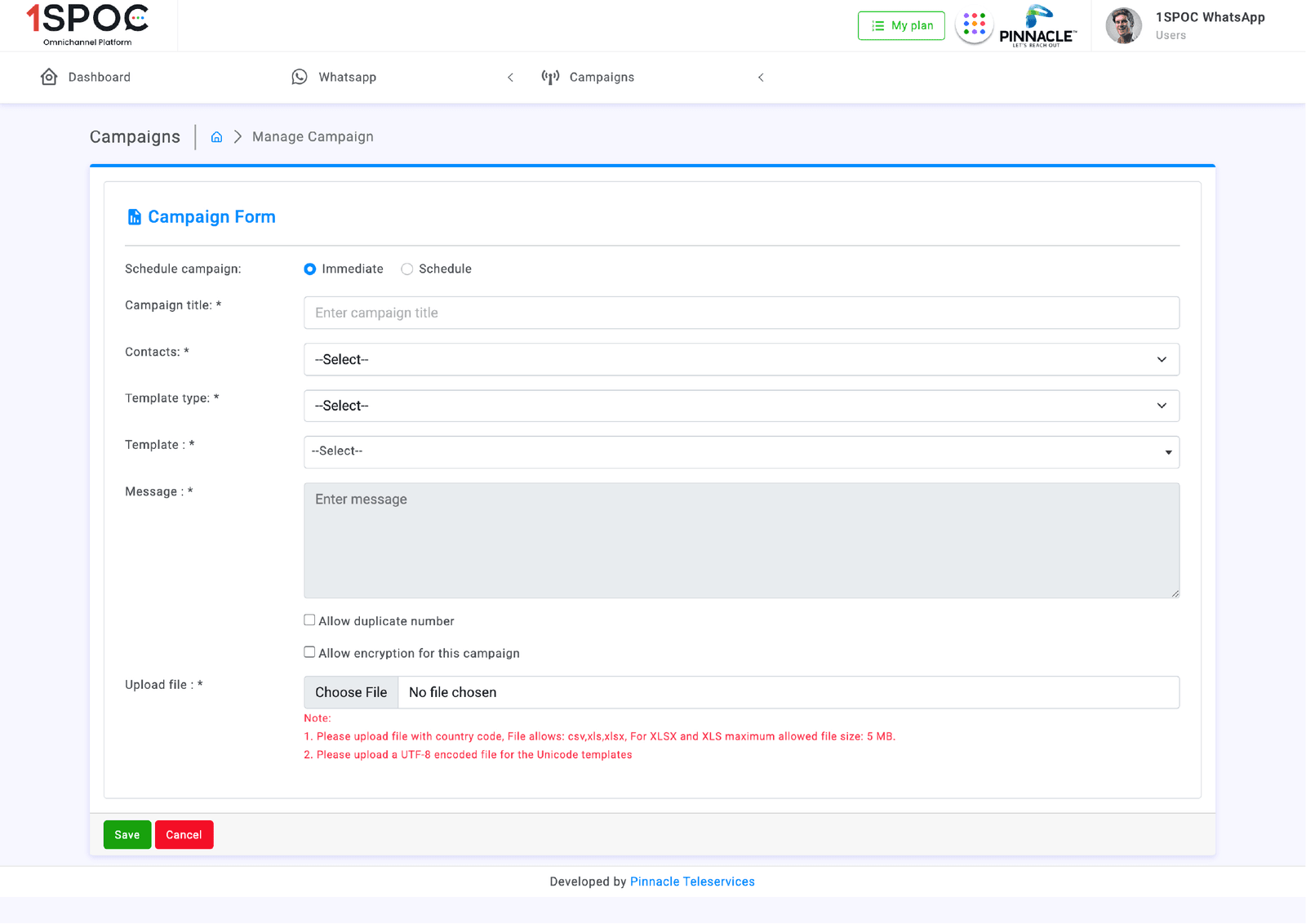 Before
“Good design is rarely the first solution. It's the result of continuous refinement, alignment, and learning.”
Platform Highlights
Rather than designing isolated features, every experience within 1SPOC was built as part of a connected enterprise ecosystem. Each module follows a shared design language while addressing the unique requirements of different communication channels and operational workflows.
Campaign Management
The command center for creating, targeting, and launching campaigns across every channel through a single guided flow.
Teams juggled separate campaign tools per channel — each with different steps, validation, and compliance handling — making the process slow to learn and error-prone at scale.
A unified four-step builder (Campaign Info → Template → Scheduling → Preview) with channel-aware validation, inline compliance, and reusable audiences.
Cut setup time and errors while giving enterprise teams one governed, consistent launch process across channels.
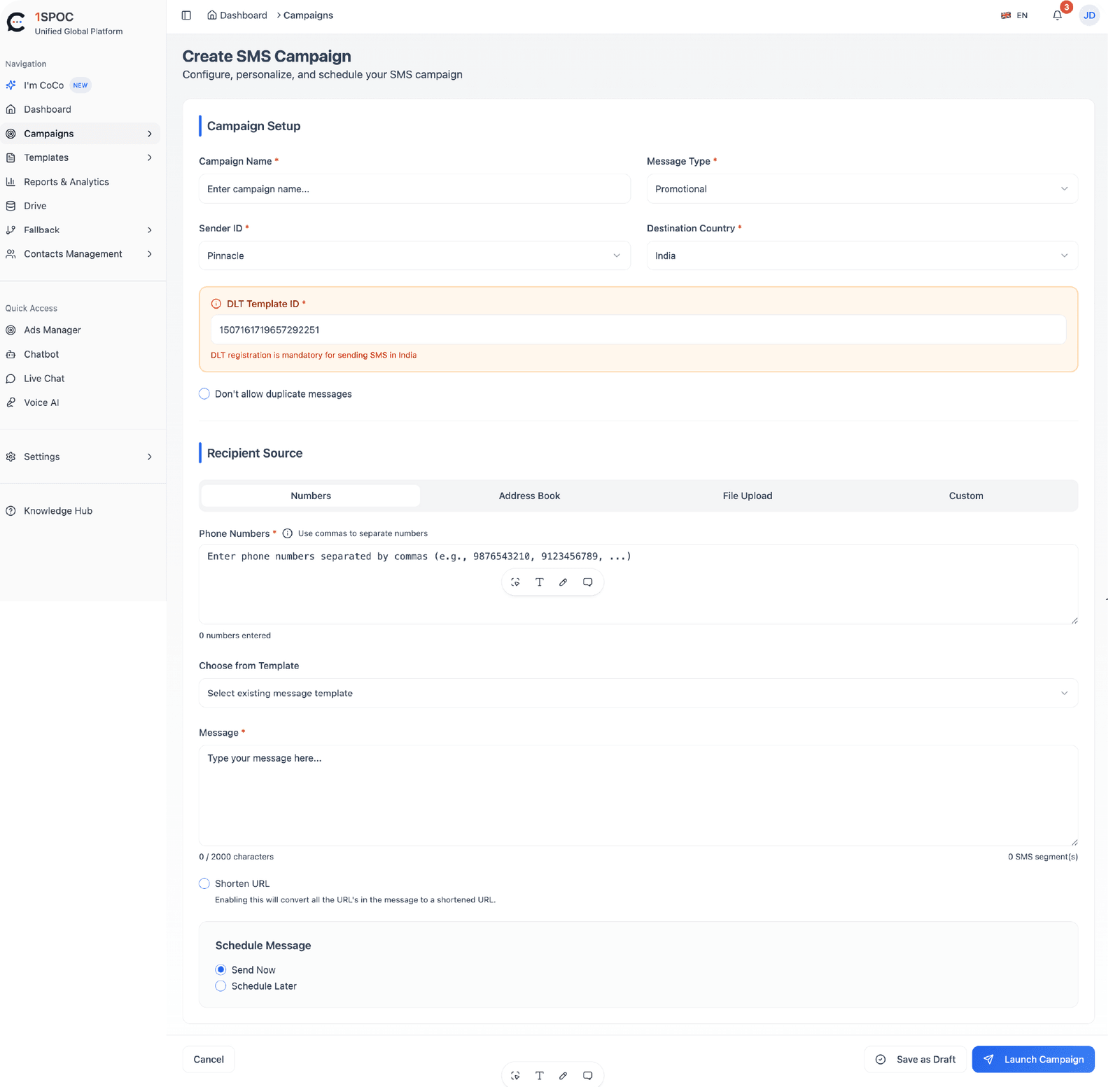
SMS Platform
High-throughput SMS with templates, sender IDs, DLT compliance, and delivery reporting for bulk, transactional, and promotional sends.
Regulatory complexity — DLT registration, sender IDs, country rules — combined with high volume made SMS operationally heavy and easy to get wrong.
A structured SMS workspace that manages templates, sender identities, and DLT alongside campaigns and delivery reports.
Made compliant, large-scale messaging predictable and auditable for enterprise operations.
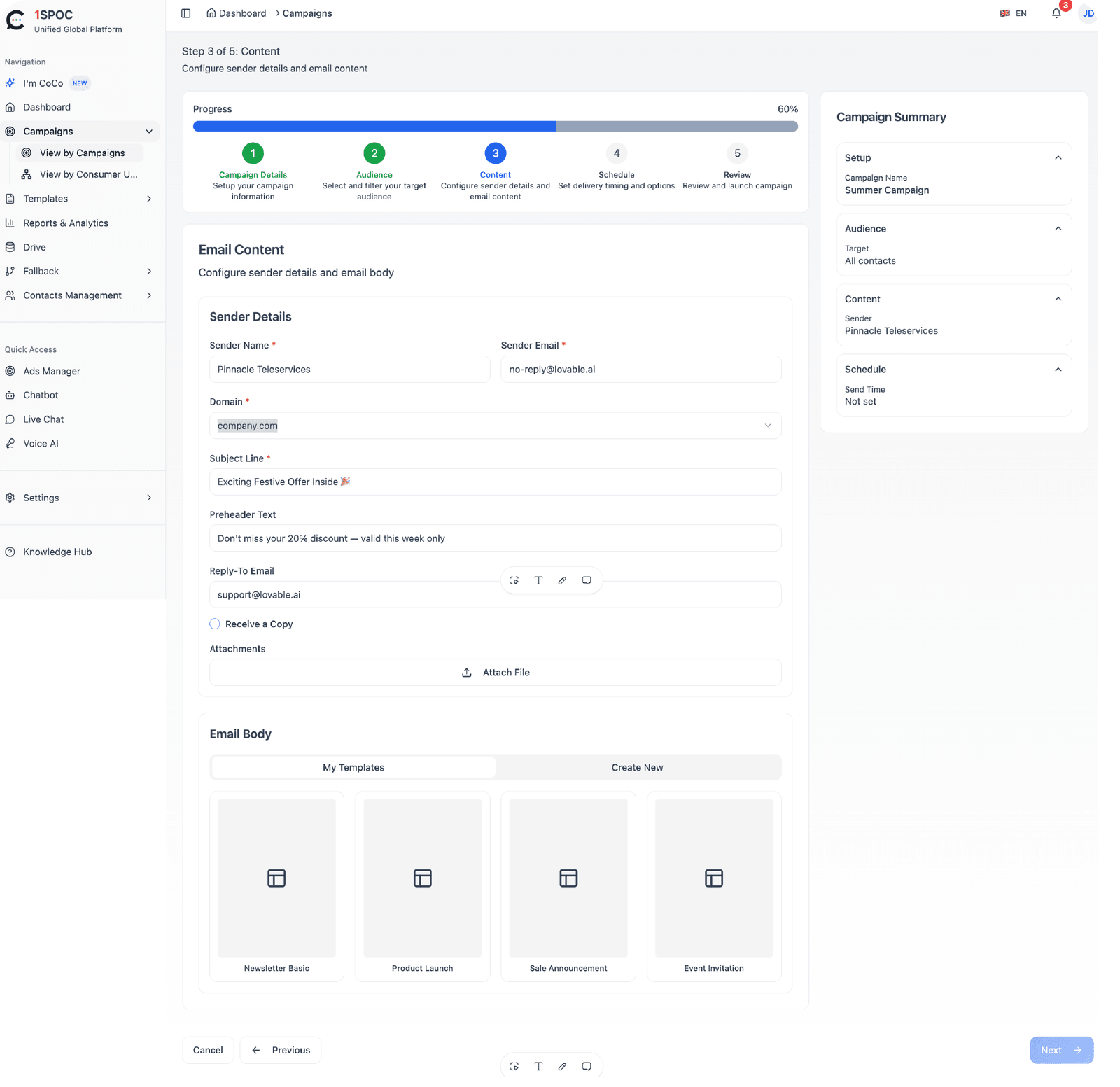
Email Platform
Transactional and promotional email with a block-based template builder, domains, sender profiles, and integrated reporting.
Email needed rich content creation without HTML expertise, plus deliverability controls enterprises could trust.
A modular template builder with a reusable block library, domain and sender-profile governance, and shared analytics.
Enabled non-technical teams to ship on-brand email while maintaining deliverability and governance.
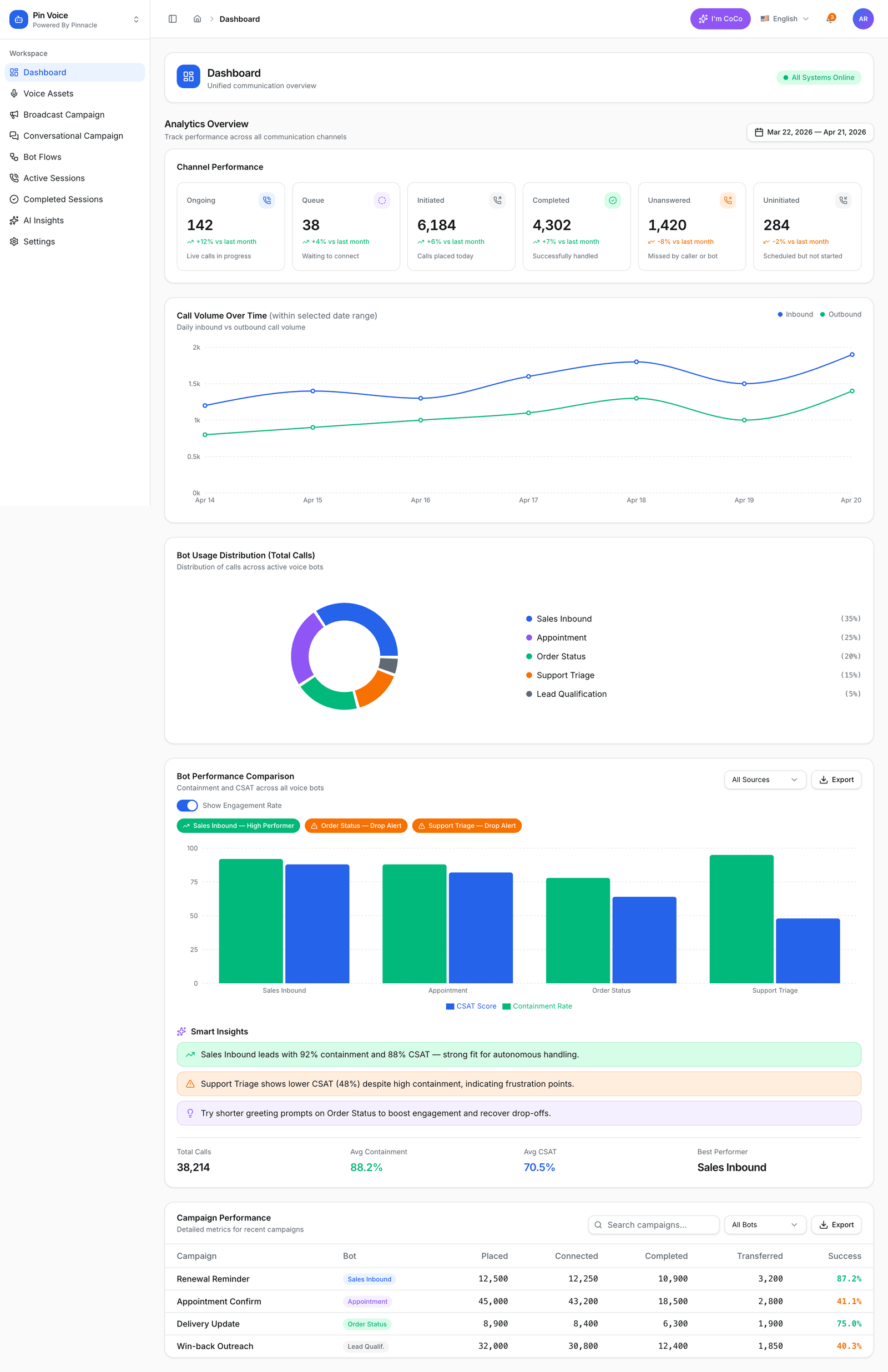
Voice AI
Voice calls, IVR, and AI voice bots with visual call flows, API integrations, and SIP / WebRTC support.
Designing conversational voice meant making complex call logic and AI configuration approachable for operational teams.
A visual call-flow and voice-bot configuration surface built on the same platform primitives as every other channel.
Brought advanced voice automation into the same governed, learnable platform as every other channel.
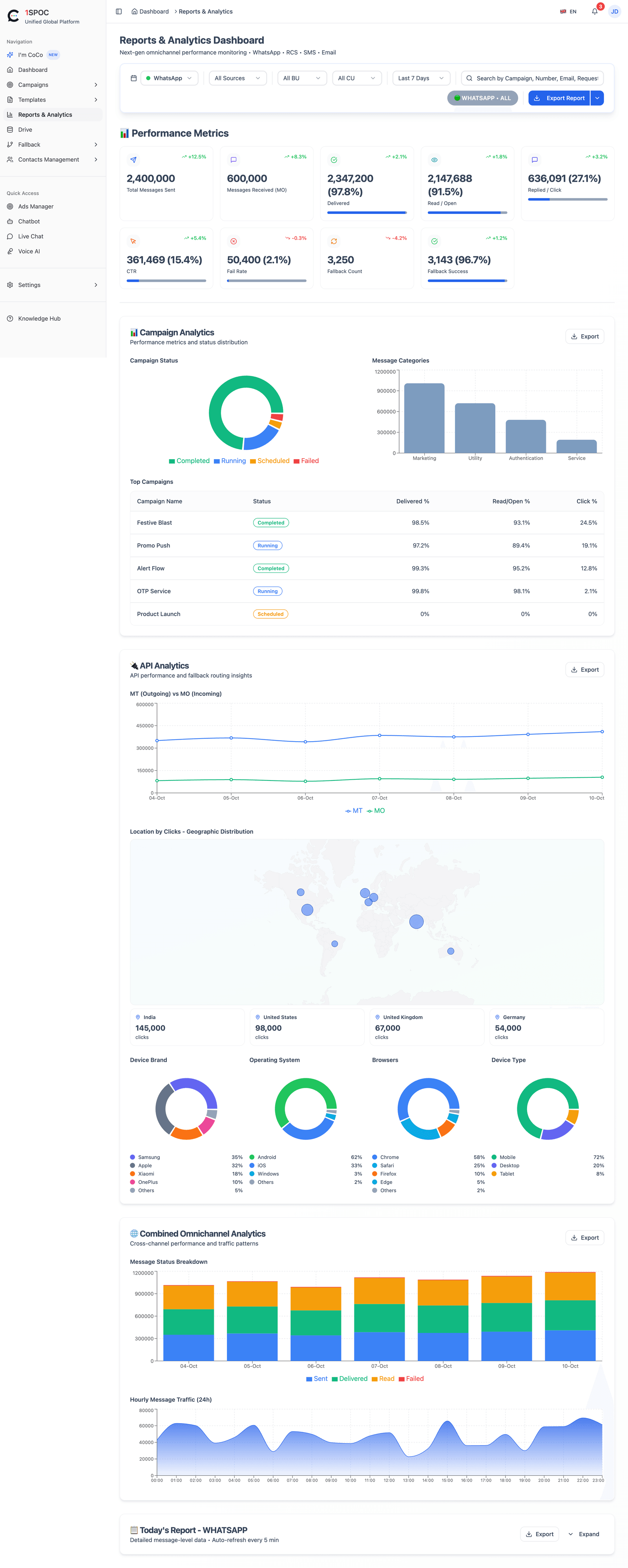
Analytics & Reporting
Cross-channel analytics — delivery, engagement, click, and conversion reporting — with an executive dashboard.
Insights were fragmented per channel, making it hard to understand performance across the whole communication program.
A unified analytics layer with one consistent metric model and an executive overview spanning every channel.
Gave leaders a single, trustworthy view of communication performance to drive decisions.
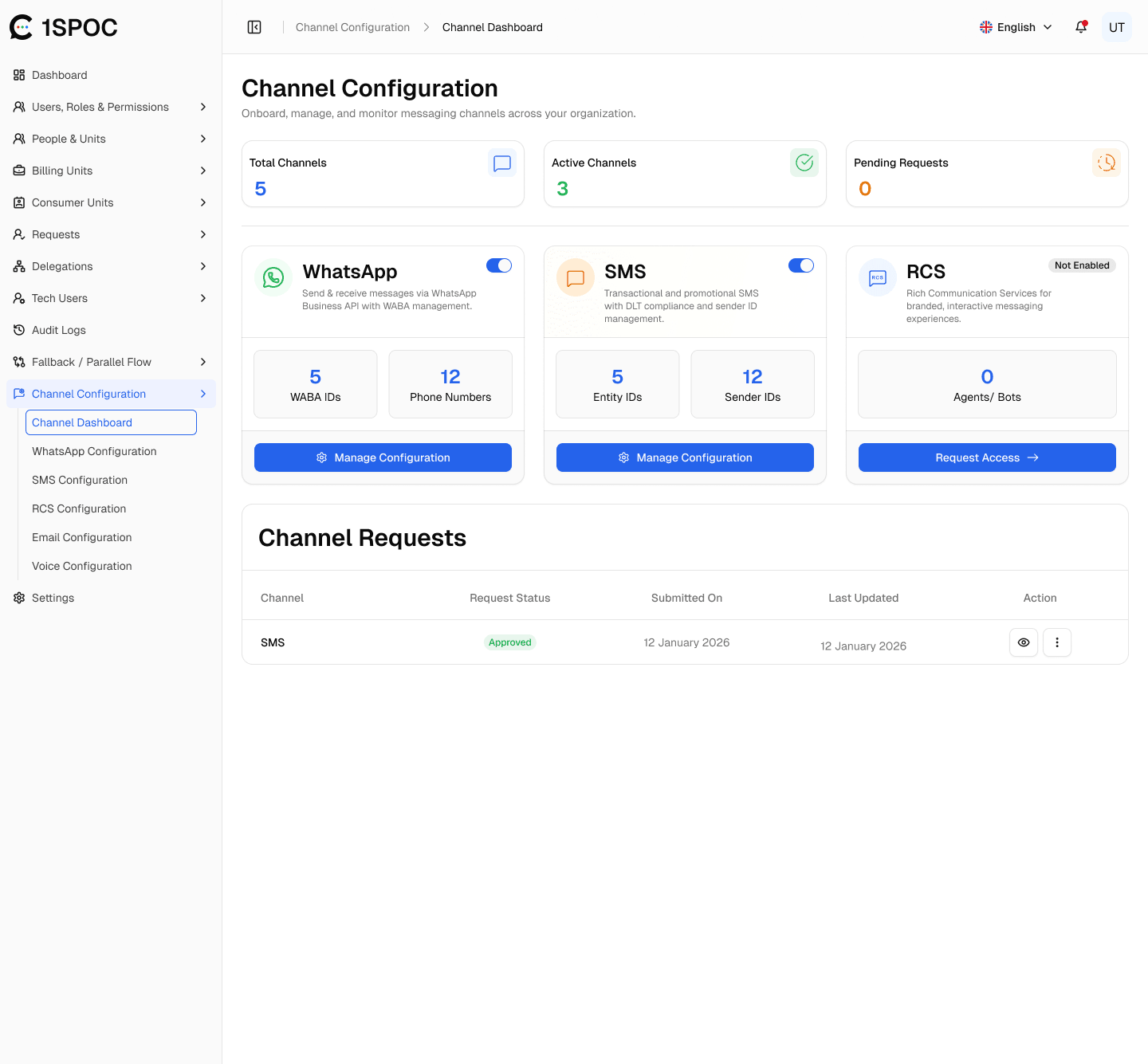
Administration
Organization, users, roles and permissions, audit logs, billing, and system settings — governance beneath every module.
Enterprises required granular access control, full auditability, and multi-team governance across the entire platform.
A centralized administration layer handling identity, permissions, audit trails, and configuration for all channels.
Made 1SPOC deployable and trustworthy at enterprise scale with real governance.
Scaling Design Through Systems
As 1SPOC expanded across multiple communication channels and enterprise workflows, maintaining consistency became increasingly important. Instead of building a design system from scratch, I adopted ShadCN as a robust foundation and extended it into a tailored enterprise design system with custom components, design tokens, interaction patterns, and reusable workflows aligned to our product ecosystem.
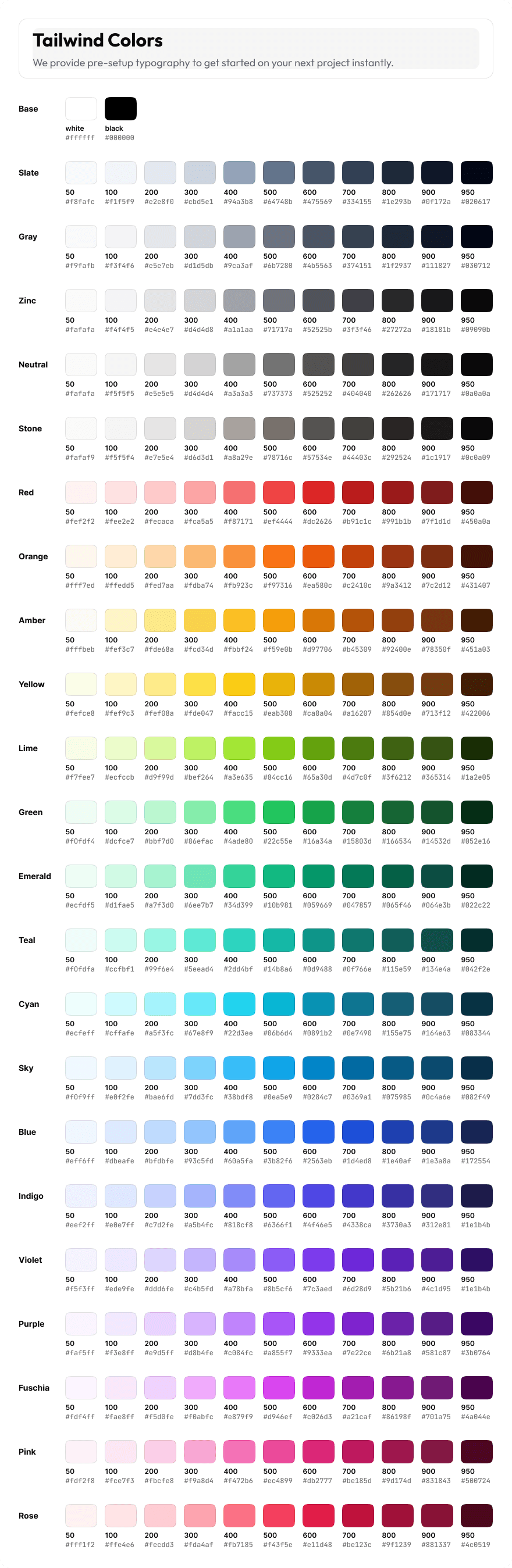
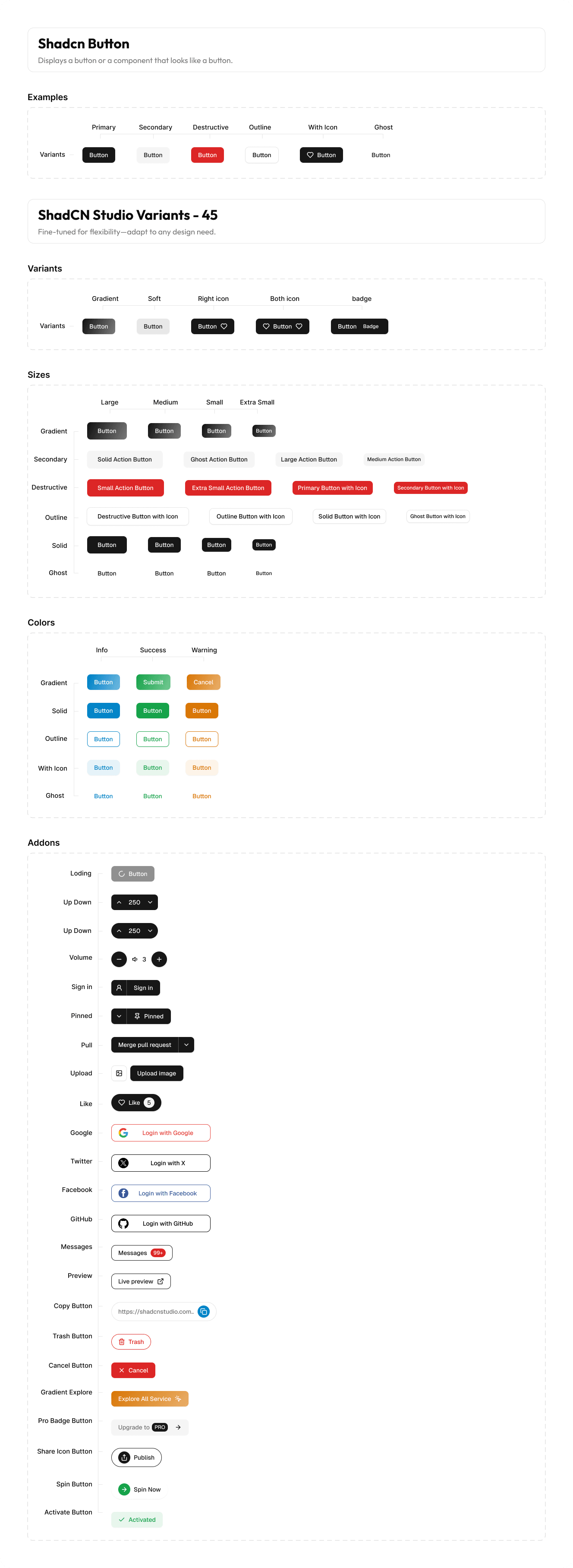
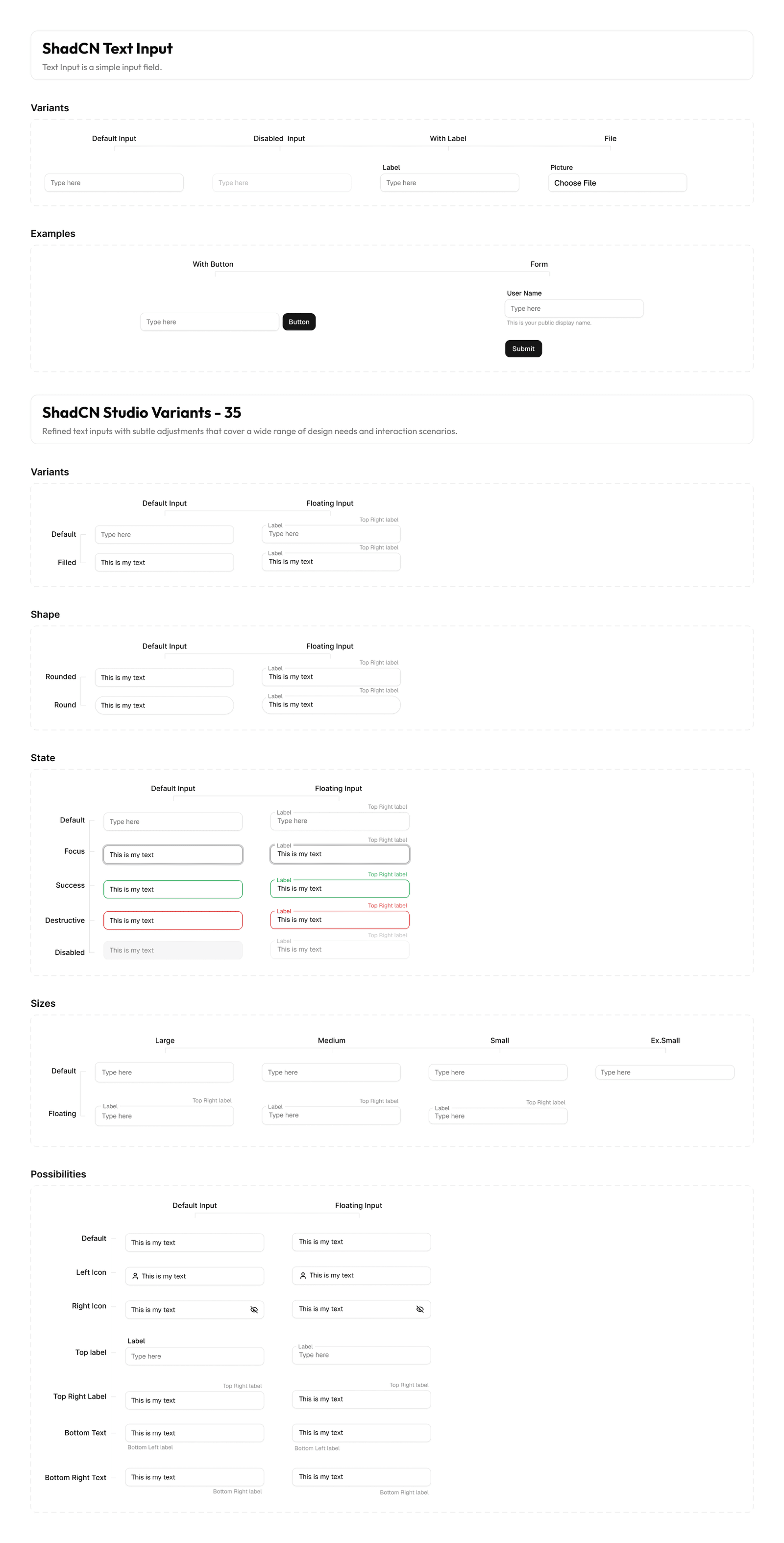
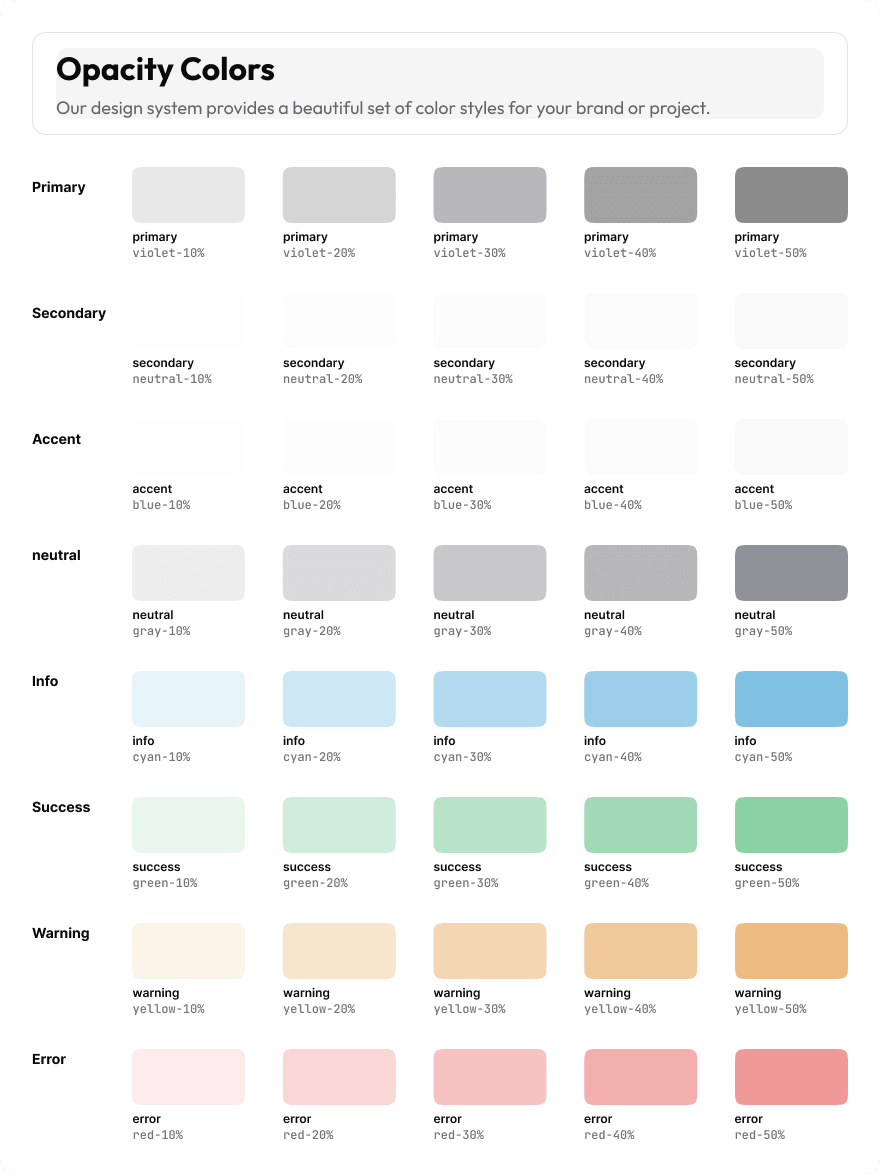
Foundation
ShadCN gave us accessible, well-structured primitives. We restyled them to the 1SPOC brand and codified the core building blocks below.
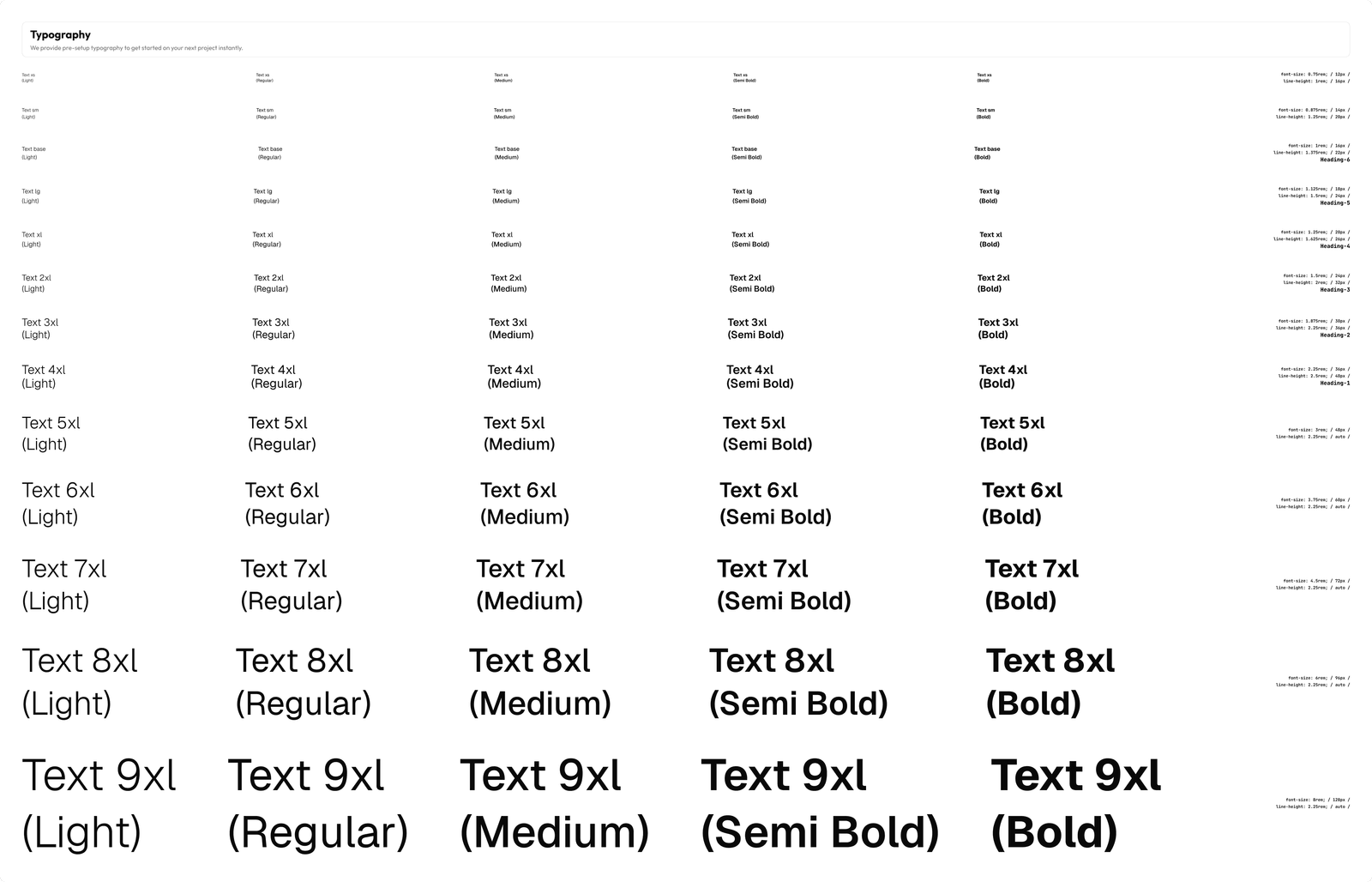
Enterprise Extensions
On top of the foundation, we built domain-specific components that ShadCN doesn't ship — the pieces that make 1SPOC an enterprise platform.
Campaign Wizard
Guided multi-step campaign creation across every channel.
Journey Builder
Visual builder for multi-step automated customer journeys.
Template Manager
Create, approve, and reuse channel templates at scale.
Permission Matrix
Granular role-based access mapped across teams and modules.
Analytics Cards
Composable metric cards for cross-channel reporting.
Data Tables
High-density, sortable, filterable enterprise tables.
Business Units
Multi-tenant hierarchy for brands, teams, and regions.
Workflow Builder
Configurable approval and automation workflows.
Design Tokens
Every visual decision is expressed as a named token rather than a hard-coded value. Update a token once and the whole platform stays in sync — the mechanism behind consistency at scale.
Shared UX Patterns
Platform Coverage
One shared design language powers every surface — each channel assembled from the same tokens, components, and patterns.
Impact
Consistency
Unified experiences across every communication channel.
Efficiency
Reusable components accelerated design and development.
Scalability
New modules inherited existing patterns without redesign.
Collaboration
A shared system improved alignment between Product, Design, and Engineering.
“A design system isn't about standardizing interfaces. It's about enabling teams to build better products faster, together.”
Designing Together with Engineering
Building 1SPOC required close collaboration between Design and Engineering from the earliest product discussions through implementation. Rather than handing over static mockups, the process focused on shared systems, reusable components, technical feasibility, and continuous iteration. This partnership ensured that every design decision was practical, scalable, and ready for development.
How We Worked Together
Technical Feasibility
Worked closely with engineers to validate ideas early while balancing user experience and implementation constraints.
Design System Alignment
Aligned reusable components, design tokens, and interaction patterns between Figma and production.
Implementation Reviews
Performed design QA throughout development to ensure consistency across spacing, typography, interactions, responsiveness, and accessibility.
Continuous Iteration
Refined edge cases and product experiences through continuous collaboration after implementation.
Developer Deliverables
Impact
Faster Development
Reusable components accelerated implementation.
Better Consistency
Shared standards reduced design-production gaps.
Higher Quality
Continuous QA improved the final product.
Scalable Delivery
A shared system enabled future features to be developed efficiently.
“The strongest products aren't built through handoffs. They're built through continuous collaboration between design and engineering.”
From fragmented tools to one connected platform.
1SPOC transformed enterprise communication from a collection of disconnected channel-specific tools into a unified omnichannel platform. By standardizing workflows, introducing a scalable design system, and simplifying complex enterprise operations, the product created a stronger foundation for future growth while improving the experience for administrators, marketers, and business teams.
Unified Experience
One coherent platform replacing disconnected channel tools.
Scalable Architecture
A modular foundation ready for new channels and capabilities.
Faster Product Development
Reusable systems accelerated design and delivery.
Better Collaboration
Shared standards aligned Product, Design, and Engineering.
Reduced Complexity
Simplified enterprise workflows and operational overhead.
Foundation for Growth
A base built to support AI, automation, and integrations.
What building 1SPOC taught me.
Designing 1SPOC wasn't about creating screens—it was about designing a product capable of evolving over time. The project reinforced that enterprise software succeeds when complexity is carefully organized, systems are built for scale, and design becomes a strategic partner rather than a downstream function.
Designing Systems Over Screens
Enterprise design isn't about individual layouts—it's about connecting workflows, people, and data into cohesive experiences that hold together as the product grows.
Collaboration Drives Quality
Continuous collaboration with Product, Engineering, QA, and stakeholders surfaced constraints early and refined the product long after the first release.
Build for the Next Release
Reusable systems, scalable architecture, and thoughtful planning meant every new feature inherited existing patterns—reducing future design effort with each iteration.
“The best enterprise products don't feel simple because they're small. They feel simple because every layer of complexity has been intentionally designed.”