One workspace for the
entire Voice AI lifecycle.
An enterprise platform to design, deploy, monitor, and continuously optimize AI-powered voice interactions—from one connected environment instead of many disconnected tools.
- Role
- Lead Product Designer
- Timeline
- Feb – Jul 2026
- Platform
- Enterprise SaaS
- Scope
- End-to-end
Project Overview
Enterprise voice communication has quietly become one of the most complex problems in modern business. As organizations adopted AI to handle customer conversations at scale, the tooling around it fragmented—conversation design lived in one place, AI configuration in another, campaign execution somewhere else, and the data needed to improve any of it nowhere anyone could act on. The Enterprise Voice AI Platform was built to close that gap: a single workspace for the entire Voice AI lifecycle, where teams design conversations, configure AI behavior, launch and manage campaigns, monitor live interactions, and continuously improve outcomes. Its vision treated unification as a strategic advantage—when design, configuration, orchestration, and analytics share one system, decisions compound and the voice channel gets measurably better over time. It was designed for the cross-functional teams who operate enterprise voice programs, making sophisticated capability approachable without hiding the depth they depend on. As Product Designer, I owned the experience end to end—product strategy, UX and information architecture, user flows, wireframing, and high-fidelity UI—established the design system that kept it coherent as it scaled, and partnered with engineering through developer handoff and design QA.
Enterprises didn't need another bot builder.
For years, enterprise voice ran on rule-based IVR—rigid systems that were difficult to modify and dependent on engineering for any meaningful change. Business teams who owned the customer conversation had almost no ability to iterate on it themselves.
As organizations adopted AI-powered voice, the problem changed shape but not severity. The ecosystem fragmented: voice configuration, prompt management, integrations, campaign execution, live monitoring, analytics, and optimization were spread across disconnected tools that were never designed to work together.
Engineering dependency
Even small conversation updates required engineering involvement, leaving business teams unable to iterate on their own.
Slow deployment cycles
Shipping or changing an AI voice experience moved at the pace of development, not the pace of the business.
Inconsistent experiences
Conversations drifted across campaigns and business units, with no shared standard holding them together.
Limited operational visibility
Teams had little insight into live conversations or how the AI was actually performing in production.
Governance at scale
Prompts, voice profiles, and multilingual experiences were difficult to control consistently across an organization.
No path to optimization
Once deployed, conversations stayed static—there were no actionable insights to keep improving them.
Fragmented workflows
Disconnected tools multiplied operational complexity and quietly eroded productivity.
Bots over lifecycle
Existing solutions focused on deploying a bot, not on managing the complete lifecycle of enterprise Voice AI.
The gap wasn't a missing feature. It was a missing operating model—one that treats voice AI as a lifecycle to be managed, not a bot to be shipped.
As enterprise adoption grew, organizations needed a single platform for the complete AI lifecycle—configuring AI behavior, designing conversations, deploying campaigns, monitoring production, and continuously optimizing performance. Not another standalone Voice Bot Builder, but the connected system where enterprise Voice AI is actually run.
Research & Discovery
Discovery set out to answer one strategic question: what does it actually take for an enterprise to run AI-powered voice — not just build a bot, but operate it responsibly at scale? The work mapped the full arc of an AI conversation — designed, configured, launched, monitored, improved — and located where that arc broke down across existing tooling. Rather than optimizing a single step, it aimed to find the seams where teams lost time, context, and control.
The central insight reframed the problem: the hard part of enterprise Voice AI isn't creating a voice bot — it's managing the lifecycle of the conversation around it.
Conversation design was gated by technical expertise
Traditional IVR and voice-automation tools assumed engineering involvement, making every change slow and developer-dependent — a bottleneck for teams who understood the conversation but couldn't build it.
AI configuration was scattered
Prompts, voice settings, language profiles, and API integrations lived across disconnected tools. A single agent's behavior was assembled from fragments no one could see in one place.
Operational visibility was largely absent
Most platforms went quiet after deployment. Without centralized monitoring, teams couldn't observe live conversations, troubleshoot failures, or judge whether the AI was performing.
Optimization was treated as an afterthought
Voice AI shipped as static automation rather than a system that learns. The signals needed to improve it — analytics, sentiment, containment, recommendations — lived far from the people who could act on them.
Governance didn't scale
Enterprises needed centralized control over prompts, voices, integrations, and AI behavior to hold a consistent, compliant standard. Distributed, tool-by-tool configuration made that practically impossible.
Each insight pointed to a design opportunity — five moves that turn the weaknesses of the old model into the shape of the new one.
Move conversation authorship from engineers to the teams who own the experience.
Bring AI configuration into one coherent surface, so behavior is legible and intentional.
Close the gap between deployment and understanding with centralized monitoring.
Feed real conversation signals back into design so the system improves over time.
Give enterprises one place to enforce consistency, compliance, and scale.
Design the product around the Voice AI lifecycle — not a catalog of features. When conversation design, configuration, monitoring, optimization, and governance share one connected environment, each strengthens the others: insight informs configuration, configuration shapes conversation, governance holds it all coherent.
The direction wasn't to build a better voice bot builder. It was to build the workspace where enterprise Voice AI is designed, operated, and continuously improved as one system — the premise every subsequent decision was measured against.
Organized around the lifecycle, not the features.
The core strategy was to structure the product around the complete operational lifecycle of Voice AI rather than a catalog of isolated capabilities. Instead of another Voice Bot Builder, the platform supports every stage of AI operations—so teams navigate by the work they're doing, and each stage flows naturally into the next.
Configure
Govern firstOrganizations establish AI governance—prompts, voice models, language profiles, integrations, and behavior—before a single conversation exists.
Create
Design without engineeringBusiness teams design reusable conversational experiences with voice assets and a visual flow builder, cutting engineering dependency and accelerating iteration.
Deploy
OperationalizeConversations go live through broadcast and conversational campaigns with structured scheduling, execution, and rollout.
Operate
Ensure stabilityOperations teams monitor live and completed sessions, recordings, transcripts, and AI performance to keep production stable.
Optimize
Improve continuouslyOperational insights become improvements through analytics, containment, sentiment, and AI-generated recommendations that feed back into design.
Why the lifecycle wins
Feature-based navigation forces teams to reassemble context every time they move between tools. A lifecycle makes the product mirror how enterprises actually work.
Enterprise Scalability
New capabilities join a stage of the lifecycle instead of becoming another disconnected tool.
Operational Efficiency
Work moves through one continuous flow, so context is never rebuilt between stages.
Systems Thinking
Each phase strengthens the next—governance shapes design, operations feed optimization.
Coherent Experience
Teams navigate by what they're doing, not by which feature happens to hold the tool.
One workspace, seven connected domains.
The architecture groups twelve capabilities into a lifecycle of connected domains — from the AI foundation and conversation design through deployment, operations, and intelligence — so teams always know where they are and where a task leads next.
Dashboard
- Overview & entry point
AI Foundation
- Voice Bot Settings
- Prompt Management
- Language Profiles
- API Integrations
- AI Configuration
Conversation Creation
- Voice Assets
- Bot Flow Builder
AI Deployment
- Broadcast Campaigns
- Conversational Campaigns
AI Operations
- Active Sessions
- Completed Sessions
- Conversation Monitoring
Intelligence & Analytics
- AI Insights
Platform Administration
- Global Settings
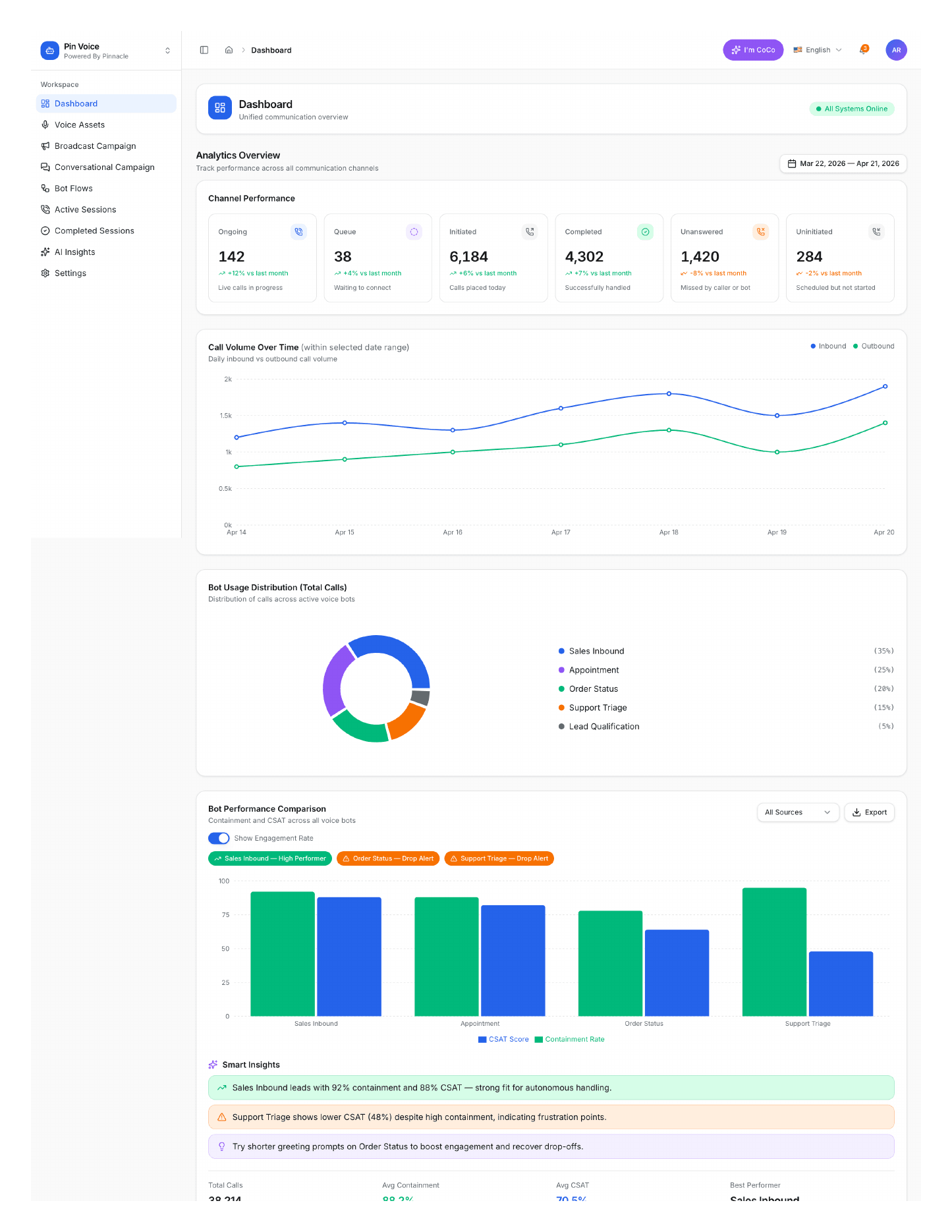
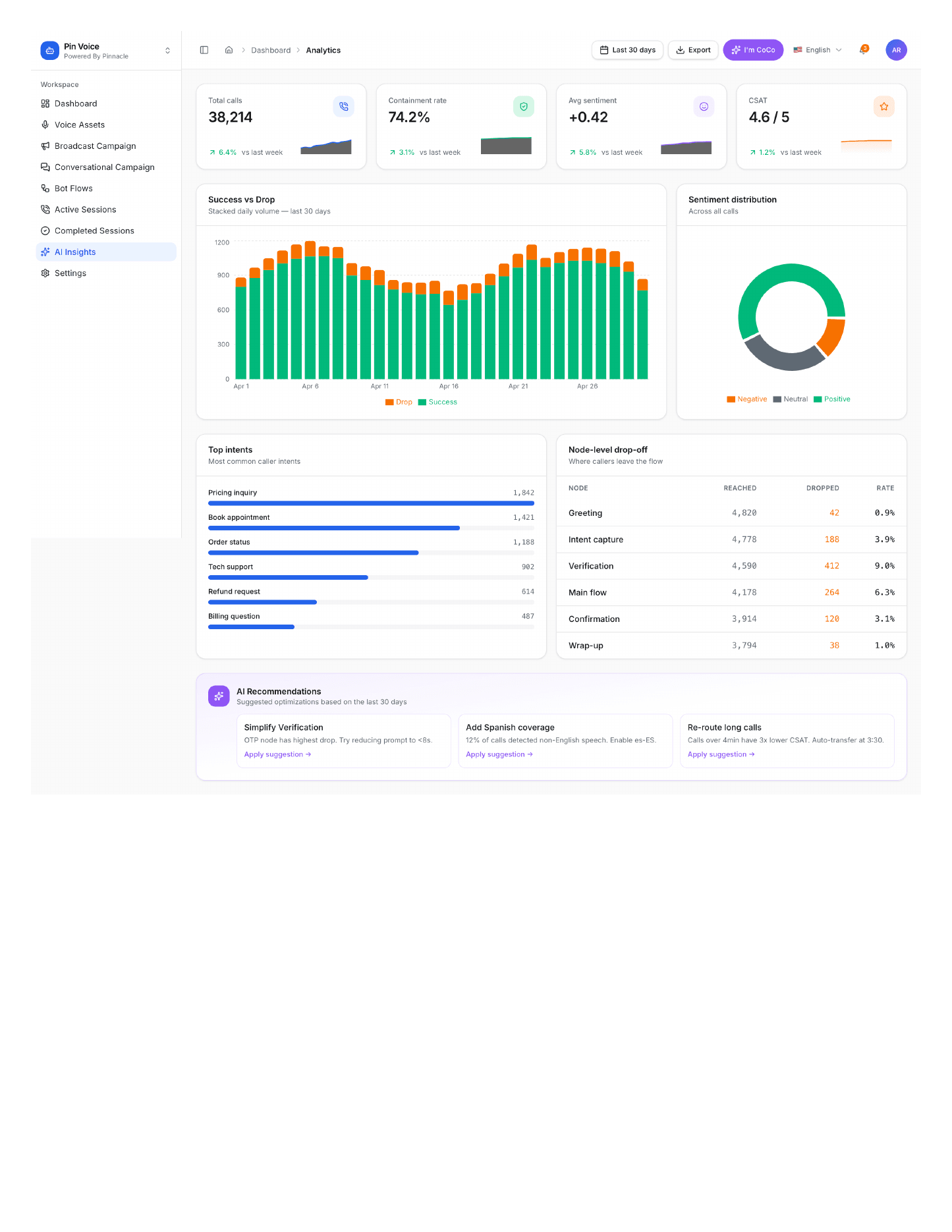
AI Dashboard
The command center. The dashboard orients a team the moment they arrive: the state of the voice program at a glance, what needs attention, and a direct path into any stage of the lifecycle. It turns a sprawling platform into a single, legible starting point.
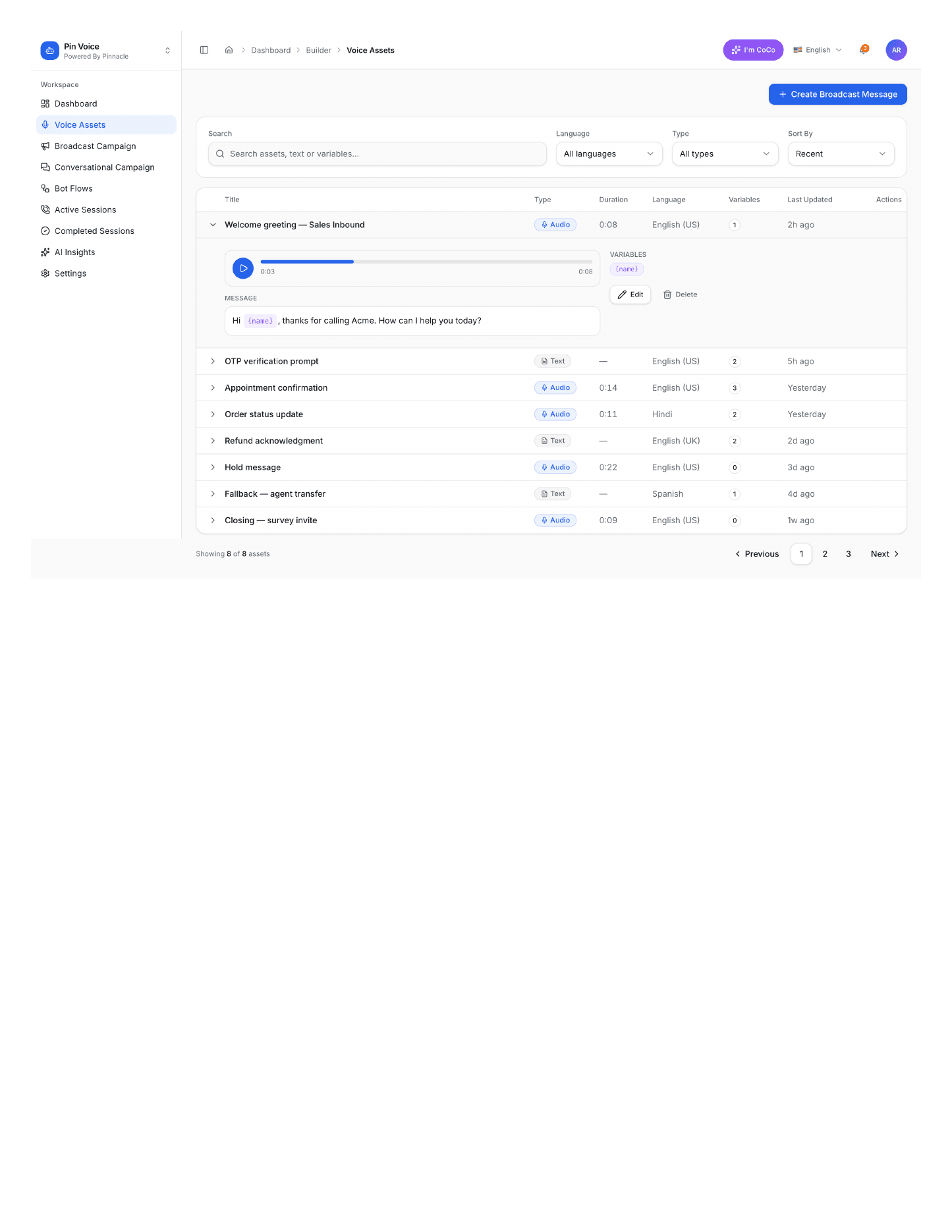
Voice Asset Management
The reusable building blocks. Voices, prompts, and language profiles are managed as shared assets—designed once and reused across flows and campaigns. Treating content as a system, not scattered files, keeps every voice experience consistent as the platform scales.
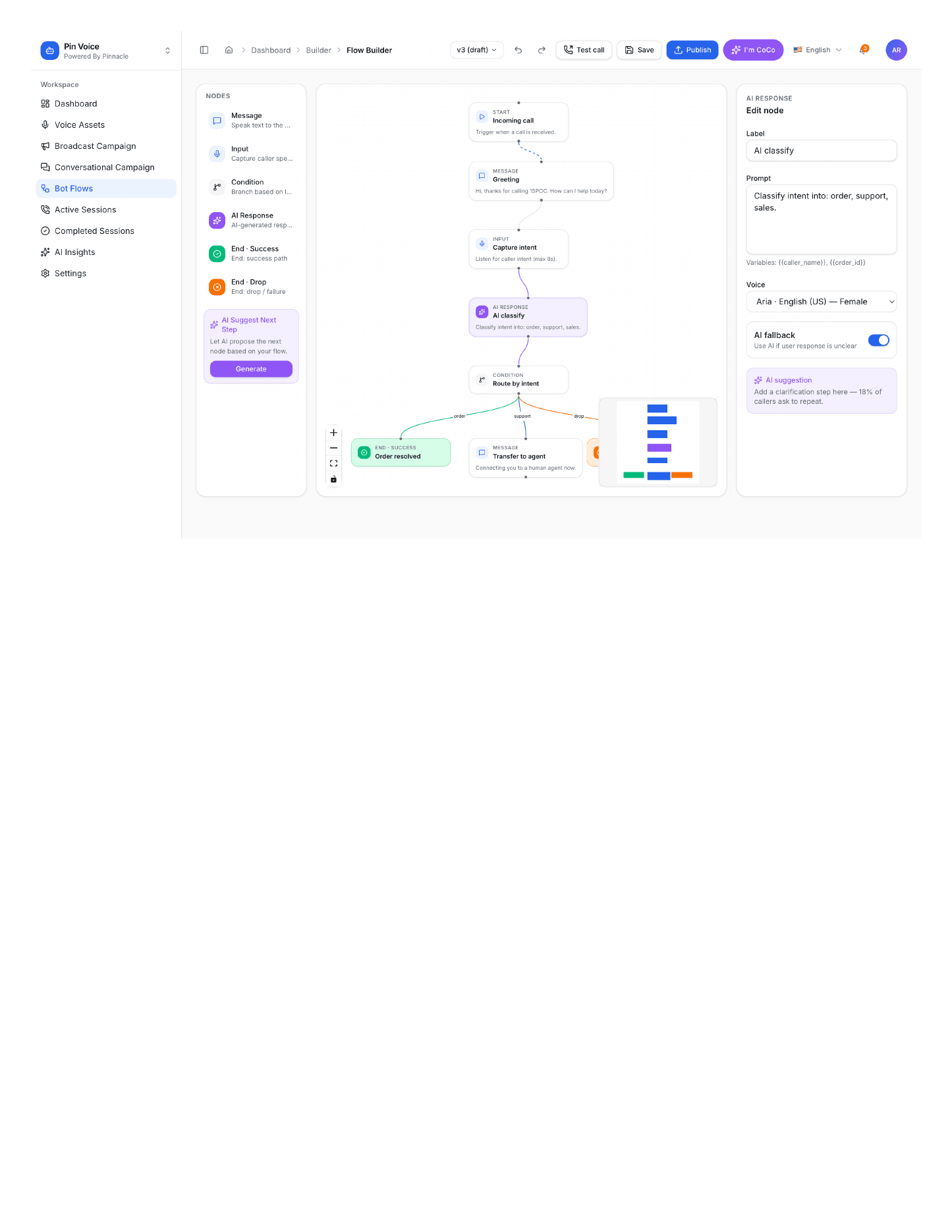
AI Flow Builder
Designing the conversation. The visual flow builder, prompt management, and voice bot configuration are where teams shape what the AI says and does. Designing for a non-deterministic system meant making branching logic, prompt behavior, and fallbacks feel structured and predictable—giving designers control over intelligence without writing code.
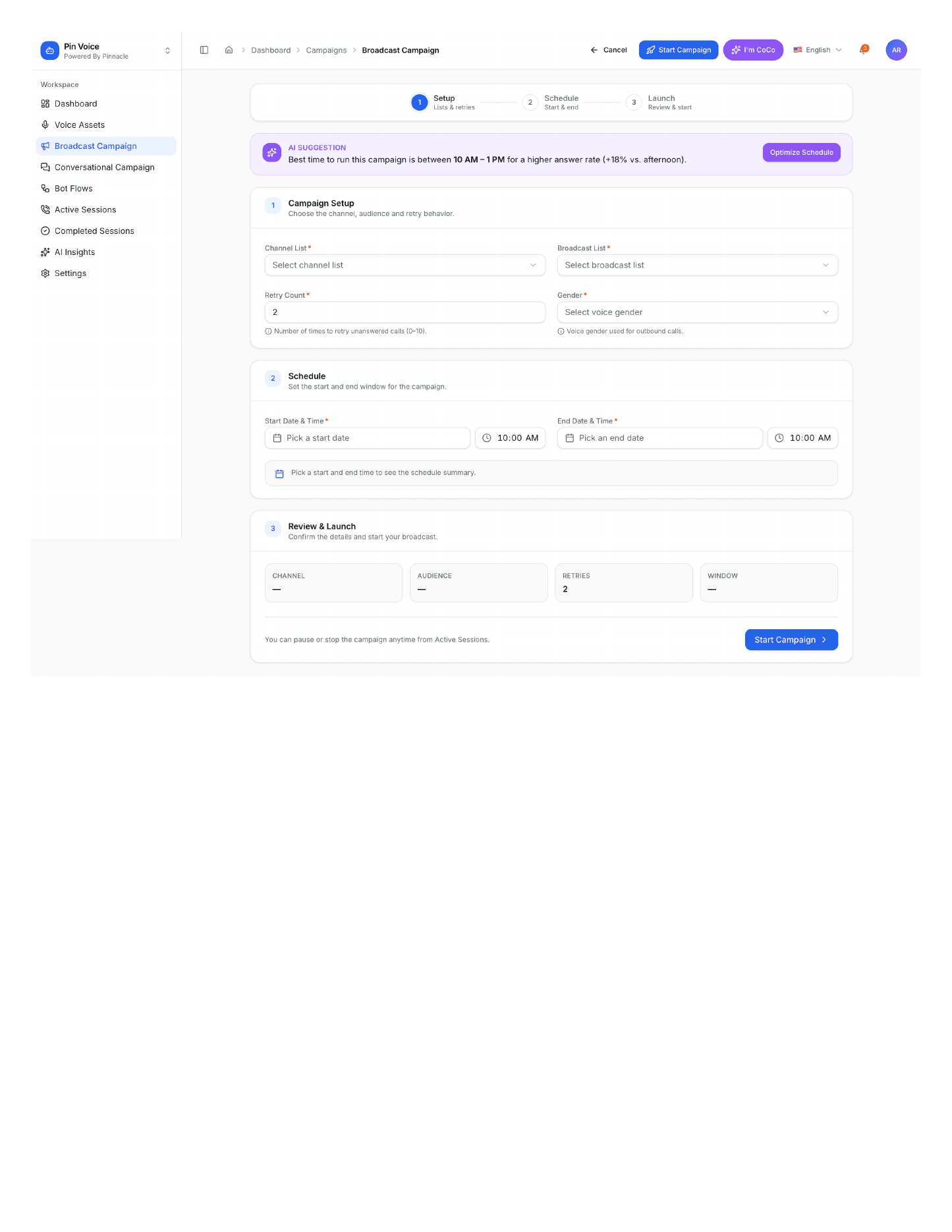
Campaign Management
From conversation to operation. Broadcast and conversational campaigns turn designed experiences into live programs. The flows prioritize clarity at every step—audience, configuration, scheduling, launch—so running voice at enterprise scale stays manageable rather than error-prone.
AI Operations & Insights
Closing the loop. Live and completed session monitoring show what's happening in real time, and analytics turn outcomes into direction. Insight feeds back into prompts and campaigns, completing the cycle that lets the system get measurably better over time.
Scaling Design Through Systems
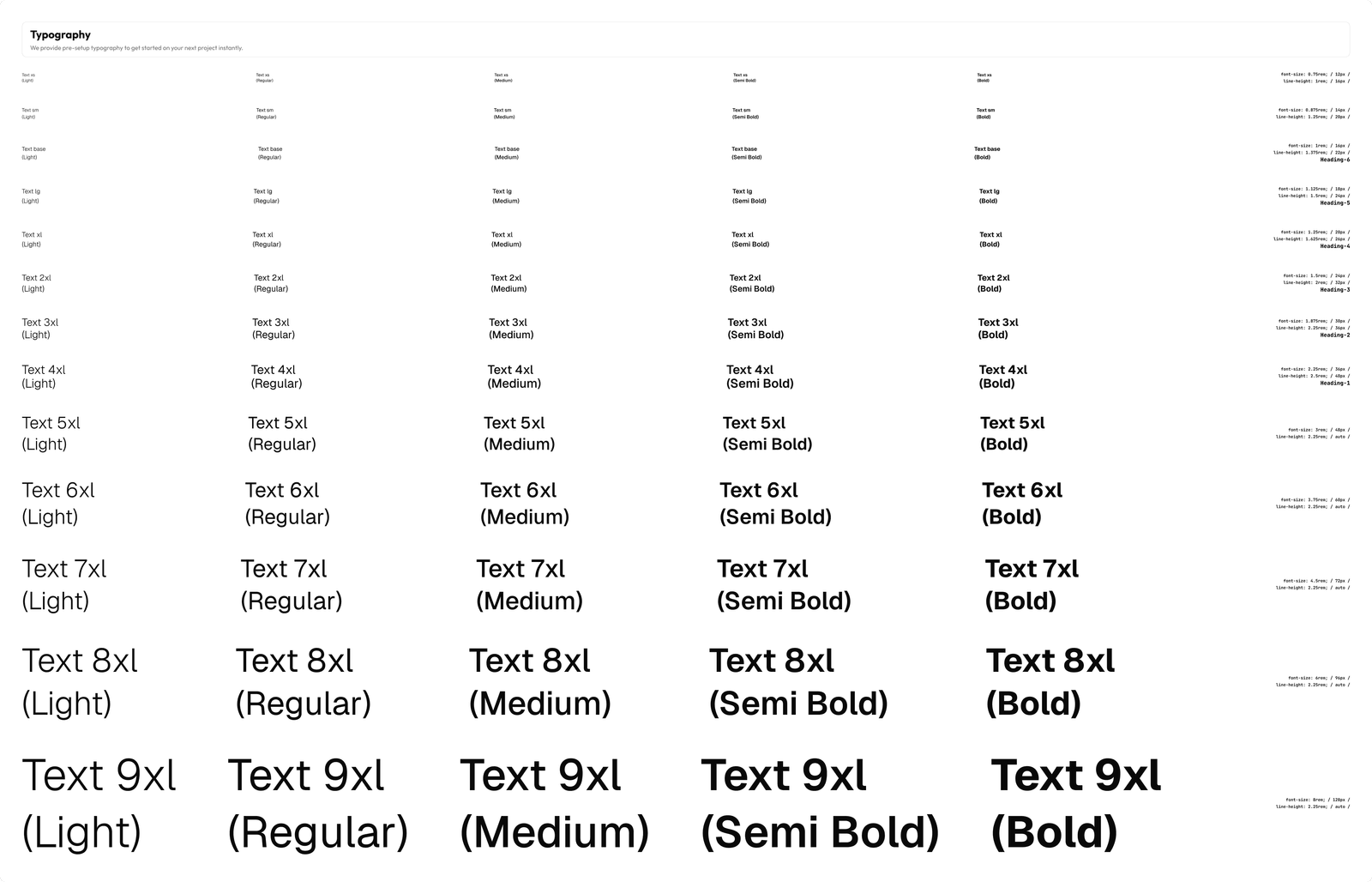
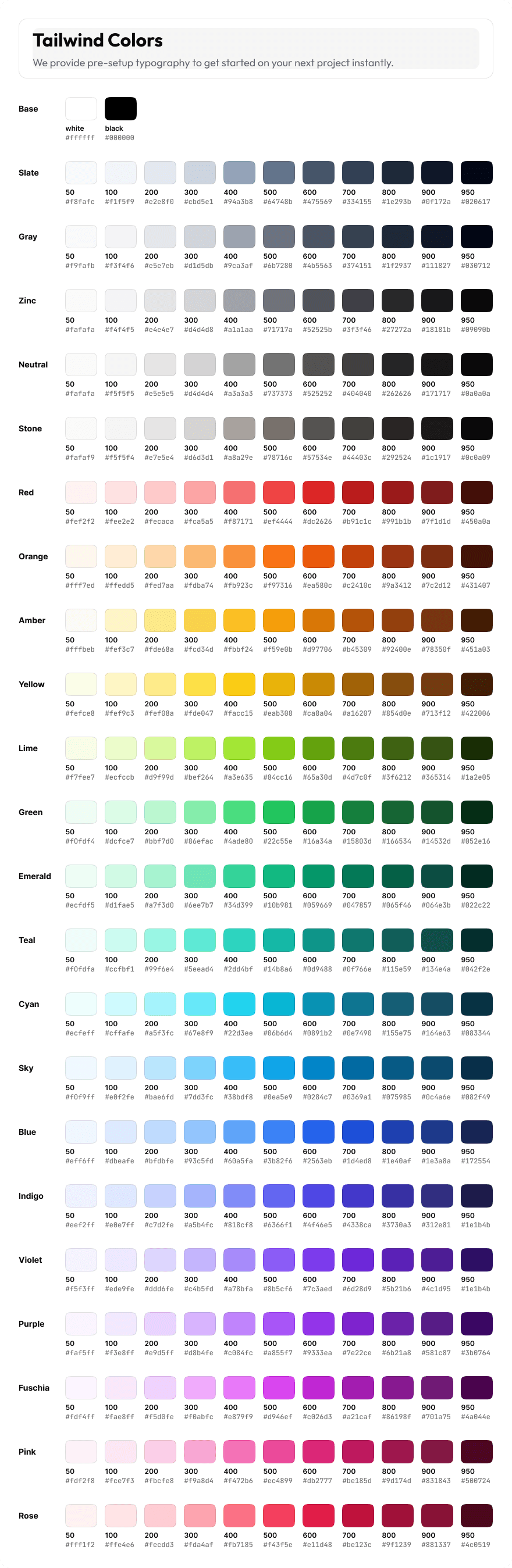
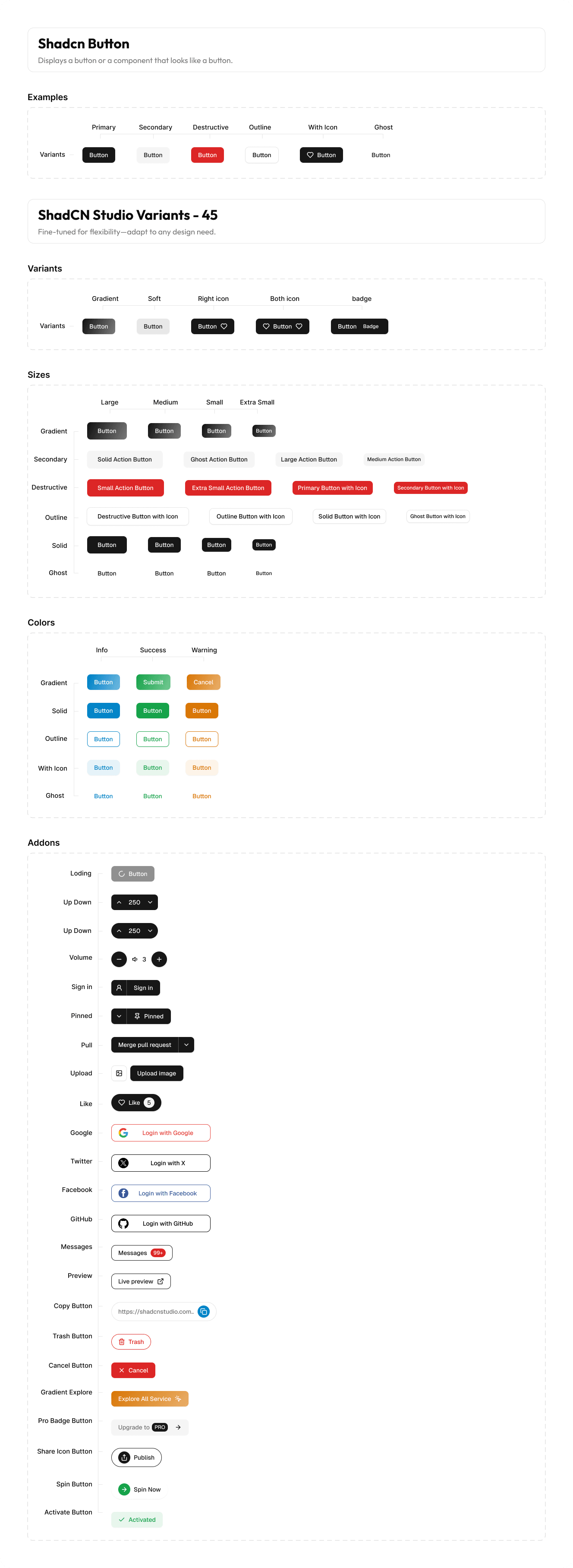
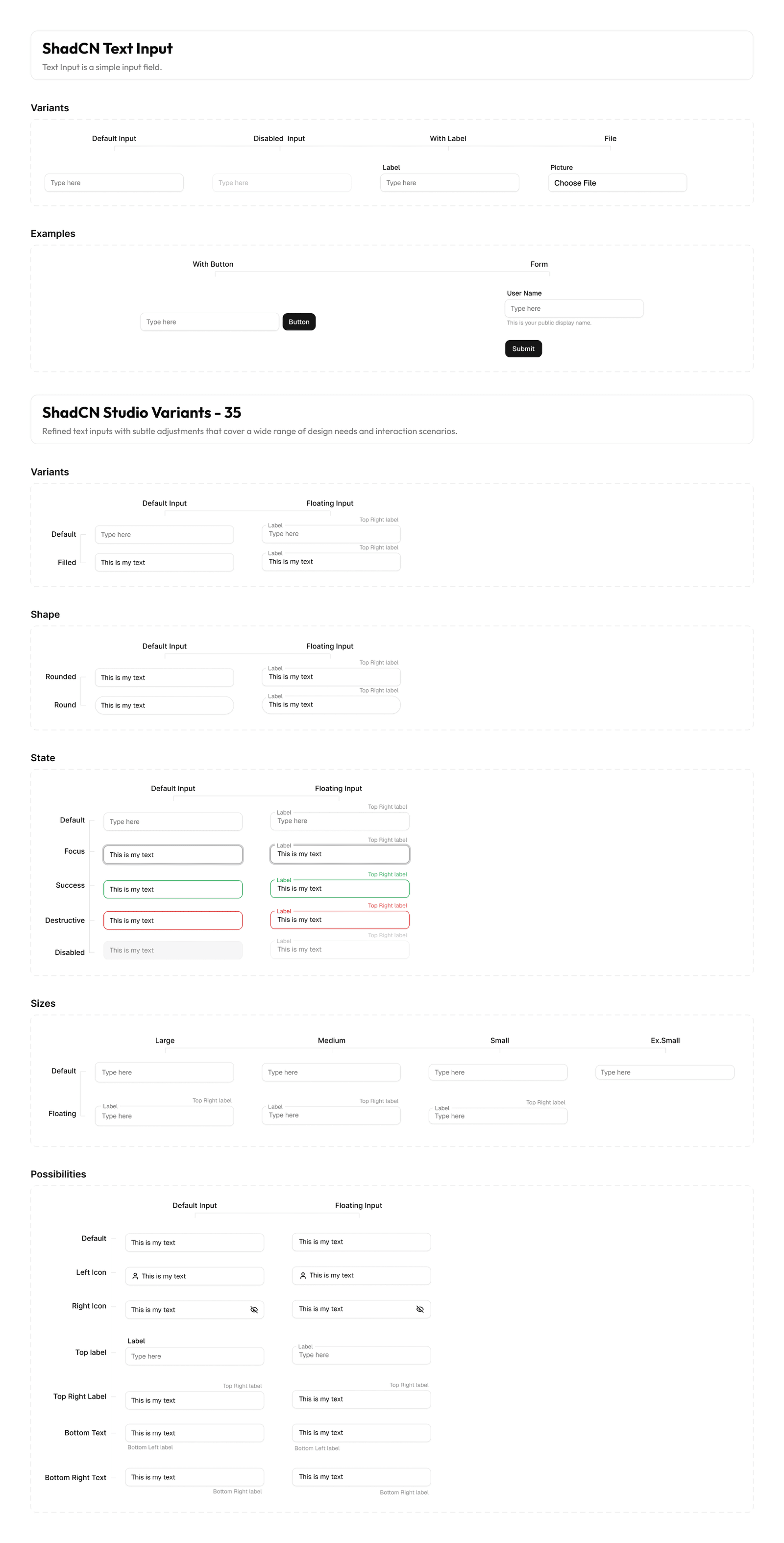
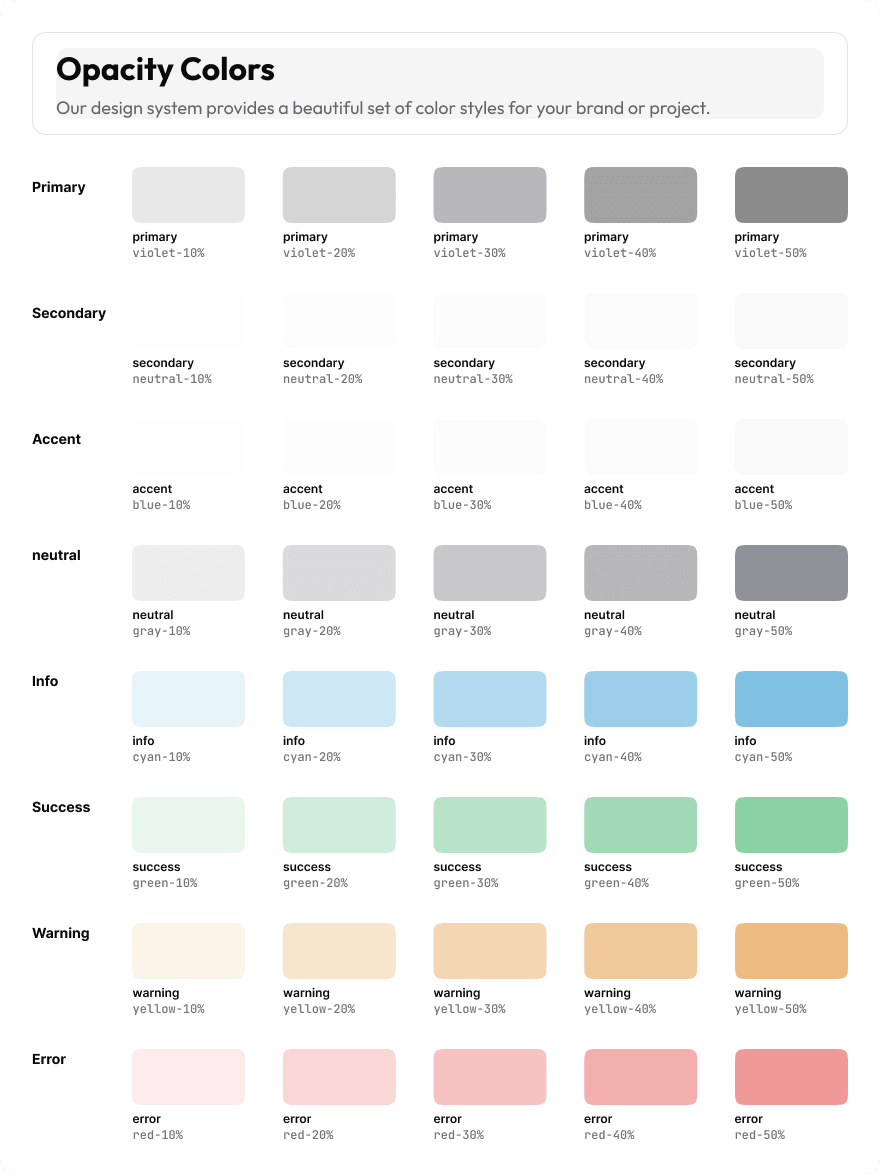
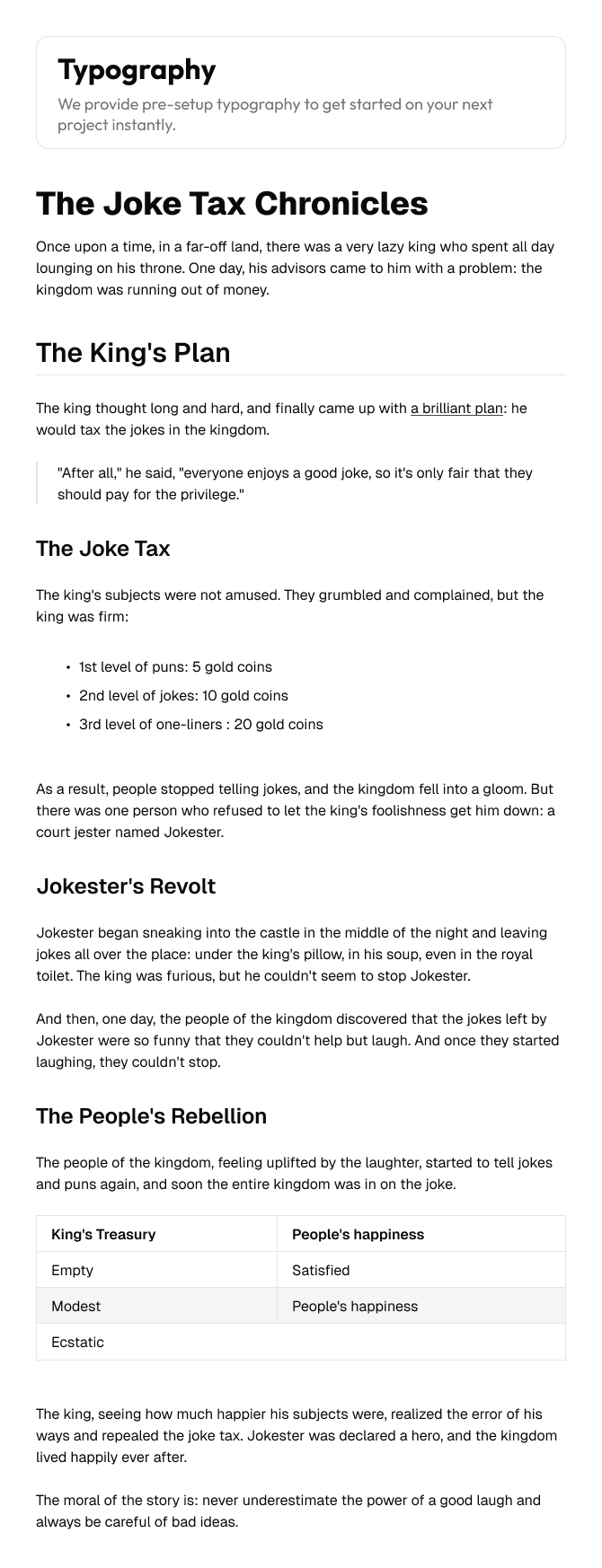
As Voice AI expanded across the Voice AI lifecycle and enterprise workflows, maintaining consistency became increasingly important. Instead of building a design system from scratch, I adopted ShadCN as a robust foundation and extended it into a tailored enterprise design system with custom components, design tokens, interaction patterns, and reusable workflows aligned to our product ecosystem.
Foundation
ShadCN gave us accessible, well-structured primitives. We restyled them to the Voice AI brand and codified the core building blocks below.
Enterprise Extensions
On top of the foundation, we built domain-specific components that ShadCN doesn't ship — the pieces that make Voice AI an enterprise platform.
Campaign Wizard
Guided multi-step campaign creation across every channel.
Journey Builder
Visual builder for multi-step automated customer journeys.
Template Manager
Create, approve, and reuse channel templates at scale.
Permission Matrix
Granular role-based access mapped across teams and modules.
Analytics Cards
Composable metric cards for cross-channel reporting.
Data Tables
High-density, sortable, filterable enterprise tables.
Business Units
Multi-tenant hierarchy for brands, teams, and regions.
Workflow Builder
Configurable approval and automation workflows.
Design Tokens
Every visual decision is expressed as a named token rather than a hard-coded value. Update a token once and the whole platform stays in sync — the mechanism behind consistency at scale.
Shared UX Patterns
Impact
Consistency
Unified experiences across every communication channel.
Efficiency
Reusable components accelerated design and development.
Scalability
New modules inherited existing patterns without redesign.
Collaboration
A shared system improved alignment between Product, Design, and Engineering.
“A design system isn't about standardizing interfaces. It's about enabling teams to build better products faster, together.”
Turning AI complexity into an enterprise experience.
The hardest part of this product wasn't the interface—it was translating non-deterministic AI workflows into experiences an enterprise could operate with confidence. That translation happened in continuous conversation with engineering: aligning on how AI behavior should be modeled, where complexity belonged, and how much of it a user should ever have to see.
Scalable AI workflows
Shaped AI workflows so engineering could implement them consistently across modules—one predictable model instead of bespoke logic per surface.
Reusable interaction patterns
Structured shared interaction patterns that held across every Voice AI module, so behavior stayed familiar as the platform grew.
Conversation flow components
Defined component behavior for visual conversation flows—how nodes connect, branch, and validate—so the builder felt logical, not brittle.
Prompt & AI configuration
Partnered with engineers to simplify prompt configuration and AI settings, hiding technical depth behind clear, governable controls.
API integration experiences
Designed integration flows that balanced technical flexibility with usability, keeping powerful configuration approachable.
Execution edge cases
Worked through the hard paths—conversation execution, campaign deployment, and operational monitoring—where reliability is decided.
AI conversation states
Designed the full state model for AI conversations: loading, success, failure, and retry—so uncertainty always had a clear, calm response.
Cross-module consistency
Held one language across dashboards, monitoring, analytics, and configuration, so the platform read as a single product.
Design QA & iteration
Supported implementation through design QA and iterative feedback, closing the gap between intent and what shipped.
The platform's simplicity was earned, not given—each technical capability had to be reasoned about together and designed down to something usable.
Close collaboration between design and engineering is what turned a set of advanced AI capabilities into a coherent, scalable enterprise product—one where the depth is available when needed and invisible when it isn't.
One workspace for the entire Voice AI lifecycle.
The design unified the complete lifecycle of enterprise Voice AI into a single operational workspace. The impact wasn't a set of new features—it was a change in how organizations work: governance, collaboration, and operations moved from fragmented and reactive to centralized and continuous.
Centralized governance
AI behavior, prompts, voices, and integrations became something organizations could set and enforce in one place—consistency by default rather than by policing.
Reduced operational complexity
A single workspace replaced a scatter of disconnected tools, collapsing the overhead of moving work and context between them.
Standardized configuration
Teams configured AI against one shared model, so behavior stayed coherent across business units instead of diverging tool by tool.
Simpler conversation design
Reusable assets and visual workflows moved authorship to the people who own the conversation, easing the dependency on engineering.
Stronger deployment workflows
Structured campaign management gave rollout a predictable shape—scheduling, execution, and control that operations could trust.
Production visibility
Monitoring and analytics turned live conversations from a black box into something teams could observe, understand, and act on.
Continuous optimization
Operational feedback and AI Insights closed the loop, so conversations kept improving after launch instead of standing still.
A scalable foundation
New AI capabilities now extend a coherent system rather than adding another silo—room to grow without fragmenting again.
The result was less a product launch than a shift in how the enterprise runs voice AI—as one connected system.
Designing AI is a different discipline.
Leading the experience design for this platform reshaped how I think about enterprise software. Designing AI products isn't traditional enterprise design with a model bolted on—the behavior is probabilistic, the workflows are operational, and the value compounds over time. That demanded a different way of working.
Design the lifecycle, not the screen
The most important decisions weren't about layouts—they were about organizing the product around how enterprises actually operate voice AI. Designing around an operational lifecycle, rather than isolated screens, is what made the platform feel coherent instead of assembled.
Depth that stays approachable
AI products live or die on the balance between capability and usability. Simplifying highly technical workflows for business users—without stripping the depth technical teams rely on—meant designing governance, roles, and information architecture as carefully as any interface.
Design past the interface
AI reshaped what design had to account for: governance, operations, non-deterministic behavior, and continuous optimization. Translating those concepts into intuitive experiences required working shoulder-to-shoulder with engineering and thinking well beyond the screen.
This project sharpened how I design enterprise AI—where product strategy, systems thinking, interaction design, and business understanding have to move as one.